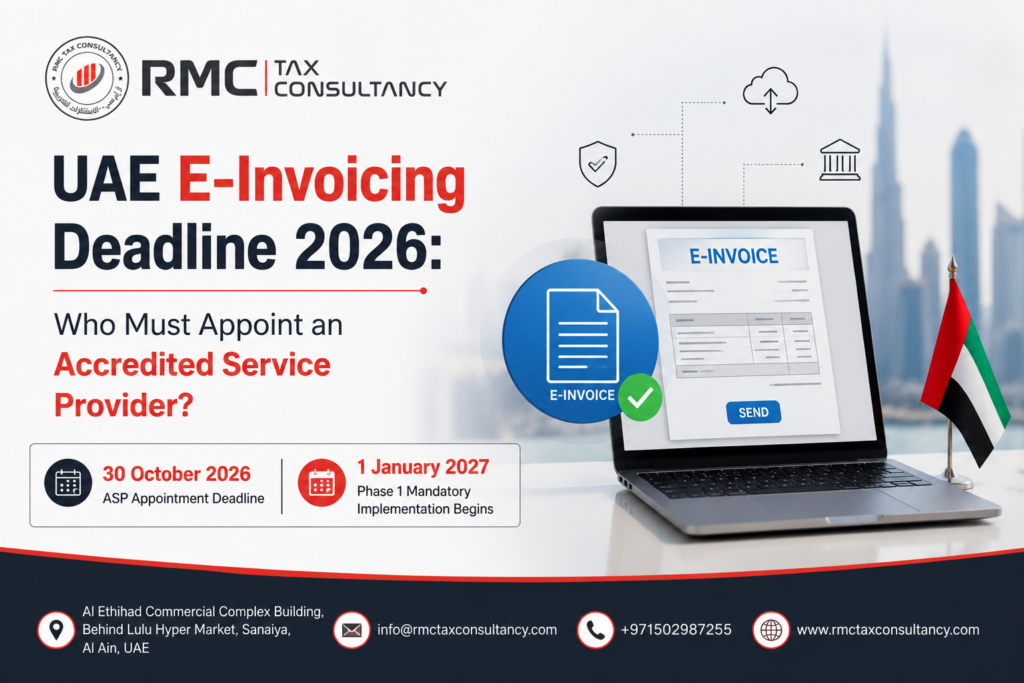
The UAE is moving towards a fully digital invoicing system, making e-invoicing an important compliance priority for businesses across the country. As part of the UAE e-invoicing programme, businesses will need to issue and exchange invoices in a structured electronic format and report relevant tax data electronically.
One of the most important dates businesses need to know is 30 October 2026. This is the current deadline for certain businesses to appoint an Accredited Service Provider (ASP) ahead of the mandatory implementation phase.
The first mandatory implementation phase is scheduled to begin on 1 January 2027. Businesses that fall within the scope of the UAE e-invoicing requirements should therefore start preparing their accounting systems, invoicing processes and technology well before the deadline.
What Is UAE E-Invoicing?
UAE e-invoicing is more than simply sending an invoice by email or converting a paper invoice into a PDF. According to the UAE Ministry of Finance, an eInvoice is a structured form of invoice data that is issued and exchanged electronically between a supplier and a buyer and reported electronically to the Federal Tax Authority (FTA).
This means that a PDF, Word document, scanned invoice, image or invoice sent as an email attachment does not automatically qualify as an eInvoice.
The UAE model is designed to make invoice exchange and tax reporting more automated, standardised and transparent.
Why Is the UAE Introducing E-Invoicing?
The move towards electronic invoicing forms part of the UAE’s wider digital transformation of the tax and business environment.
The system is intended to help businesses improve invoice processing, reduce manual errors, strengthen compliance and improve the availability of financial information.
For businesses, the transition can also create practical benefits such as:
- Faster invoice processing
- Fewer manual data-entry errors
- Better financial visibility
- More efficient record keeping
- Improved invoice tracking
- Easier tax compliance
- Better integration between accounting and business systems
The Ministry of Finance also highlights the potential for e-invoicing to reduce invoice processing costs and improve cash-flow management through faster and more standardised invoice exchange.
What Is an Accredited Service Provider (ASP)?
An Accredited Service Provider, or ASP, is a service provider that participates in the UAE e-invoicing system and facilitates the electronic exchange and reporting of invoice information.
In the UAE’s model, the ASP plays an important role between businesses and the wider e-invoicing network.
A simplified view looks like this:
Business → Accredited Service Provider → Buyer / Buyer ASP → FTA reporting
The ASP helps transmit and process invoice information according to the technical requirements of the UAE e-invoicing framework.
The Ministry of Finance describes the UAE model as a Decentralized Continuous Transaction Control and Exchange (DCTCE) model. The process involves structured invoice data, validation, exchange between service providers and reporting of tax data.
This is why choosing the right service provider should not be treated as a simple software purchase. Businesses need to consider whether the provider can support their invoicing volume, accounting environment, ERP integration, security and compliance requirements.
What Is the UAE E-Invoicing ASP Deadline in 2026?
The current deadline businesses should pay attention to is:
30 October 2026: Deadline for applicable businesses to appoint an Accredited Service Provider (ASP).
The mandatory implementation phase begins on:
1 January 2027: Phase 1 mandatory e-invoicing implementation.
The Ministry of Finance has published the latest legislative and programme information through its official UAE e-invoicing portal. Businesses should continue checking the official guidance because implementation requirements can develop as the programme progresses.
Important Dates at a Glance
| Date | What it means |
|---|---|
| 30 October 2026 | Applicable businesses need to appoint an Accredited Service Provider |
| 1 January 2027 | First mandatory e-invoicing implementation phase begins |
| Before implementation | Businesses should assess systems, processes, data and integration requirements |
The key point is simple: businesses should not wait until January 2027 to begin preparation.
Who Must Appoint an Accredited Service Provider?
This is one of the most important questions businesses are asking about the new system.
The requirement to appoint an ASP depends on whether the business falls within the applicable scope and implementation requirements under the UAE e-invoicing framework.
Businesses that fall within the relevant mandatory implementation category should assess their position early and take the necessary steps to appoint an appropriate ASP.
A business should consider factors such as:
1. Business size and revenue
Revenue thresholds can affect the timing and scope of e-invoicing obligations. Businesses should assess their annual revenue and applicable implementation category rather than assuming that every UAE business follows the same timeline.
2. VAT and tax position
Businesses operating within the UAE tax environment should review how their existing VAT invoicing, accounting and reporting processes will interact with the new e-invoicing requirements.
3. Type and volume of transactions
Companies generating a high volume of invoices may need stronger automation and system integration than businesses with relatively simple invoicing operations.
4. Accounting and ERP systems
Businesses should determine whether their current accounting software or ERP system can connect with an ASP and support the required structured invoice format.
5. Business-to-business transactions
Companies dealing regularly with other UAE businesses should review how electronic invoice exchange will affect their existing sales and purchasing processes.
Does Sending a PDF Invoice Count as E-Invoicing?
No.
This is an important distinction.
A PDF invoice may be digital, but it does not automatically qualify as a UAE eInvoice.
The UAE Ministry of Finance specifically distinguishes structured electronic invoice data from unstructured formats such as PDFs, Word documents, images, scanned copies and email attachments.
Think of it this way:
PDF invoice
Invoice created → PDF generated → Email sent
UAE eInvoice
Invoice data created in a structured format → Validated and exchanged through the e-invoicing network → Relevant tax data reported electronically
This difference means businesses should review their current invoicing process instead of assuming that existing digital invoices already meet the new requirements.
How Should Businesses Prepare for the 2026 Deadline?
Preparation should begin with understanding the business’s current invoicing and accounting environment.
Step 1: Review Your Current Invoicing Process
Identify how invoices are currently created, approved, issued, stored and shared. Look for manual processes that may create problems during the transition.
Step 2: Check Your Accounting or ERP System
Speak with your accounting software or ERP provider and determine whether the system can support UAE e-invoicing requirements and integration with an ASP.
Step 3: Assess Your Transaction Volume
Businesses with thousands of invoices each month may have very different technical requirements from a smaller company issuing a limited number of invoices.
Step 4: Evaluate Accredited Service Providers
Do not select an ASP based only on price. Consider:
- UAE e-invoicing compatibility
- ERP and accounting integration
- Data security
- Reliability
- Technical support
- Scalability
- Invoice processing capacity
- Reporting capabilities
- Implementation support
The Ministry of Finance also provides guidance on considerations for selecting an Accredited Service Provider.
Step 5: Review Your Data
Make sure customer information, supplier information, tax details, product or service descriptions and other invoice data are properly maintained. Poor-quality master data can create unnecessary problems when automated invoicing begins.
Step 6: Test Before the Deadline
Businesses should allow sufficient time for system configuration, integration, testing and employee training. Waiting until the final weeks can create avoidable operational pressure.
What Happens If a Business Ignores E-Invoicing Preparation?
E-invoicing should not be treated as simply another software update. It can affect finance teams, sales departments, purchasing teams, accounting systems and internal approval processes.
If a business delays preparation, it may face problems such as:
- Incompatible accounting systems
- Incorrect invoice data
- Integration delays
- Staff training issues
- Manual workarounds
- Delayed invoice processing
- Compliance risks
The UAE has also established legislation relating to violations and administrative penalties under the e-invoicing framework. Businesses should therefore understand their obligations rather than relying on assumptions or outdated information.
UAE E-Invoicing and VAT Compliance
E-invoicing is closely connected with the way businesses manage their tax records.
Accurate invoice information is important for VAT compliance, accounting records and financial reporting. A well-designed e-invoicing process can reduce manual data entry and improve the consistency of information used across accounting and tax processes.
However, e-invoicing does not replace the need for proper VAT compliance.
Businesses still need appropriate accounting records, correct tax treatment, proper documentation and timely tax reporting.
The real advantage comes when invoicing, accounting and tax processes work together instead of operating as separate systems.
How to Choose the Right E-Invoicing Service Provider
Choosing an ASP should be treated as a business decision rather than simply a technical decision.
Before selecting a provider, ask:
- Can it integrate with our accounting or ERP system?
- Can it handle our expected invoice volume?
- Does it support the required UAE e-invoice format?
- How is business data protected?
- What technical support is available during implementation?
- Can the system scale as our business grows?
- What are the implementation and ongoing costs?
A provider that works well for a small company may not necessarily be suitable for a large organisation with complex ERP systems and high transaction volumes.
UAE E-Invoicing: What Businesses Should Do Now
The 30 October 2026 ASP deadline gives businesses a clear preparation milestone before mandatory implementation begins in 2027.
The best approach is not to wait for the final deadline.
Businesses should first determine whether they fall within the applicable requirements, review their current invoicing systems, assess their accounting software, evaluate suitable ASPs and prepare their teams for the transition.
For companies with complex accounting systems or high transaction volumes, early preparation can make the implementation considerably smoother.
Why Choose RMC Tax Consultancy for UAE E-Invoicing Support?
Understanding the new e-invoicing framework can be challenging when businesses are already managing VAT, Corporate Tax, accounting and day-to-day financial responsibilities.
RMC Tax Consultancy provides tax, accounting, audit and business advisory services to UAE businesses, with its roots in Al Ain and services covering businesses across the UAE. The firm’s services include accounting, Corporate Tax, VAT, internal audit, business valuation, ICV consultancy and e-invoicing support.
For businesses preparing for UAE e-invoicing, RMC can help review existing financial processes, identify compliance requirements and support businesses in preparing for the transition.
If you are looking for a tax consultancy in Al Ain to help your business understand UAE e-invoicing, VAT and wider tax compliance requirements, RMC Tax Consultancy can provide practical guidance based on your business structure and financial processes.
Do not wait until the deadline. Start assessing your e-invoicing readiness now.
Posted in E-invoicing