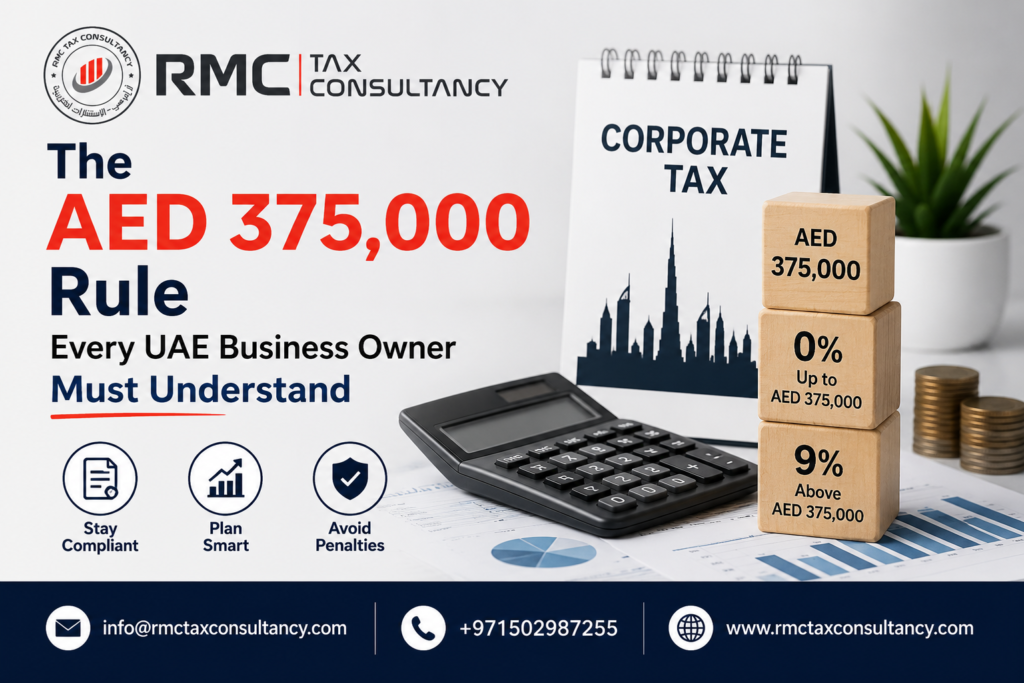
Many UAE business owners believe that if their company earns less than AED 375,000, corporate tax does not apply to them. This misunderstanding has already caused confusion among startups, SMEs, freelancers, and growing businesses across the UAE.
The AED 375,000 rule is not an exemption from corporate tax registration or filing requirements. Instead, it is the taxable income threshold that determines whether your business pays 0% or 9% Corporate Tax.
Understanding this rule correctly can help your business remain compliant, avoid penalties, and plan finances more effectively.
What Is the AED 375,000 Rule?
Under the UAE Corporate Tax regime, businesses pay:
- 0% Corporate Tax on taxable income up to AED 375,000.
- 9% Corporate Tax on taxable income above AED 375,000.
This means that if your taxable income is AED 350,000, your corporate tax liability is zero. However, if your taxable income reaches AED 500,000, only the amount above AED 375,000 is taxed at 9%.
A Simple Example
Assume your company has a taxable profit of AED 500,000.
- First AED 375,000 = 0% Corporate Tax
- Remaining AED 125,000 = 9% Corporate Tax
Corporate Tax payable:
AED 125,000 × 9% = AED 11,250
Many business owners mistakenly assume they will pay 9% on the full AED 500,000. This is incorrect and often creates unnecessary concern among SMEs and startups.
Taxable Income Is Not Revenue
One of the biggest mistakes businesses make is confusing revenue with taxable income.
Revenue is the total amount your business earns from sales or services.
Taxable income is what remains after deducting eligible business expenses such as:
- Employee salaries
- Office rent
- Utilities
- Marketing expenses
- Professional fees
- Depreciation and allowable expenses
A company generating AED 2 million in annual revenue may still have taxable income below AED 375,000 after deducting operating expenses.
This distinction is extremely important when estimating your Corporate Tax obligations.
Does Every Business Need to Register for Corporate Tax?
Yes.
Even if your taxable income is below AED 375,000 and your tax payable is zero, eligible businesses are generally still required to register for Corporate Tax and submit their tax returns within the prescribed deadlines.
Failing to register because you assume no tax is payable can result in unnecessary penalties and compliance issues.
The AED 3 Million Rule Is Different
Many businesses confuse the AED 375,000 threshold with the AED 3 million Small Business Relief threshold.
These are two completely different rules.
The AED 375,000 threshold determines the amount of taxable income subject to 0% Corporate Tax.
The AED 3 million threshold relates to Small Business Relief available to eligible businesses with annual revenue not exceeding AED 3 million for qualifying tax periods ending on or before 31 December 2026.
Understanding the difference between these two thresholds is essential for accurate tax planning.
Why This Rule Matters More in 2026
As the UAE Corporate Tax framework matures, the Federal Tax Authority is increasing compliance monitoring and enforcement activities.
Businesses that maintain proper accounting records, accurate bookkeeping, and timely tax filings are far better prepared for audits and regulatory reviews.
Waiting until year-end to understand your tax position can create cash flow problems and unexpected liabilities.
Businesses that review their financial statements monthly are usually in a stronger position to manage tax obligations and make informed decisions.
Five Questions Every UAE Business Owner Should Ask
1. Do we know our current taxable income?
2. Are our accounting records updated every month?
3. Are all allowable expenses properly documented?
4. Have we completed Corporate Tax registration?
5. Are we eligible for Small Business Relief?
If the answer to any of these questions is no, it may be time to review your accounting and tax processes.
How Professional Accounting Helps
Accurate accounting does more than maintain compliance.
It helps business owners:
- Monitor profitability.
- Improve cash flow management.
- Prepare for Corporate Tax filing.
- Identify deductible expenses.
- Reduce financial risks.
- Make better business decisions.
Many businesses discover potential tax savings opportunities simply by improving the quality of their financial records.
How RMC Tax Consultancy Can Help Your Business
The AED 375,000 rule is one of the most important numbers every UAE business owner should understand in 2026.
It does not determine whether your business must register for Corporate Tax. It determines how much of your taxable income is taxed at 0% and how much is taxed at 9%.
Businesses that understand this distinction early can avoid compliance issues, improve financial planning, and make smarter decisions for long-term growth.
With Corporate Tax now firmly established in the UAE business environment, proactive accounting and tax planning have become essential for every business, regardless of size.
Posted in Business Services